Português
 Español
 English
Direct answer
Direct answerSegment your list by language and country in your email platform. Build a post-purchase sequence per language with access confirmation at 24 hours, reinforcement at 3 days, and next step at 14 days. Validate consent with double opt-in in Europe. Use your own domain, authenticate SPF and DKIM, and test whether your email lands in the inbox in each market. Abandoned cart has its own separate flow.
Why segment your list by language and country
Because a US buyer wants English, a European wants Spanish, and a Brazilian wants Portuguese. Email in a language the buyer doesn't speak has low open rates and zero clicks. When your subject line and body land in their native language, conversion rises, churn falls, and you avoid the spam folder for looking foreign or automated.
Segmenting by country also matters because time zones, context, and business days differ. An email sent at 9am Eastern Time arrives when a European is eating lunch. When you segment by country, the tool sends during their local business hours, the email lands at the right moment, and conversion rises again.
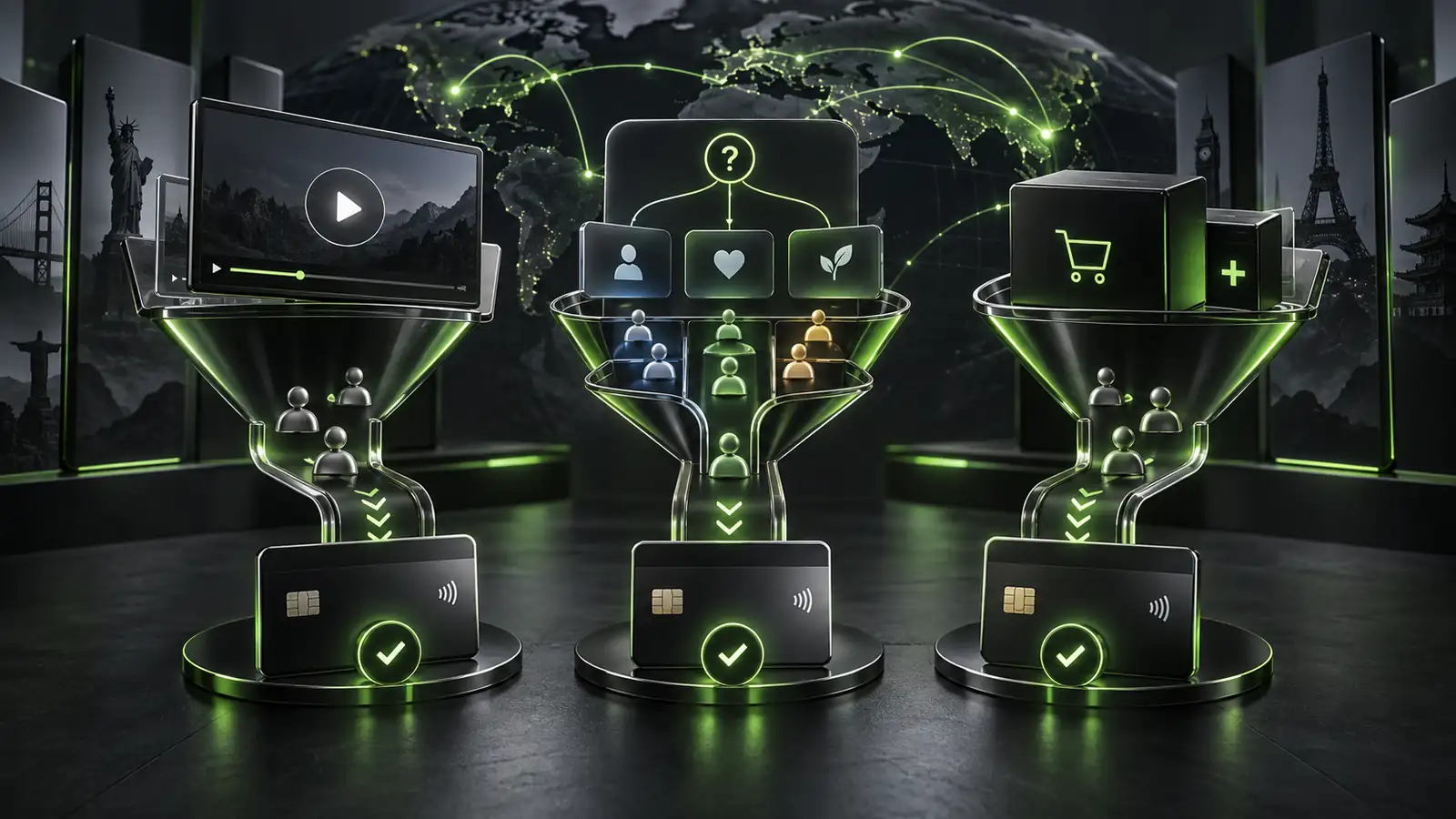
In practice: one list for English subscribers, one for Spanish, one for Portuguese. Each gets the same sequence, rewritten. When a customer purchases, the system detects their IP and places them in the list for their language and country.
How to segment your list
Add a language or country field to checkout and use that field to segment in your email platform. Tools like ActiveCampaign, MailerLite, and Omnisend let you segment by language and country in one place.
- Add field: Create a "language" or "country" field in your email tool and keep it to split your lists by country.
- Create lists: In your email tool, create one list per language and country (br, es-mx, es-es, en-us, en-uk). More setup work, fewer problems later.
- Automate: The post-purchase sequence starts when they pay, and each customer gets their language version. Not machine translation, but rewritten for the market.
- Test: Buy from each country yourself, check what language and time the first email lands, check if it hit spam. If it did, adjust and test again.
To learn the full funnel strategy, see best international sales funnels. For customers who abandon their cart, there's a separate recovery flow at abandoned cart recovery.
What post-purchase sequence works
A sequence that confirms access, delivers fast value, and sets up the next sale. Standard sequence: four or five emails in the first month, then one every 14 days.
- Email 1 (24 hours): Access confirmation. Subject: "Your account is ready, here's your link". Simple instructions, no hunting required.
- Email 2 (3 days): First lesson or quick win. Show a result they can get in the first few days. Goal: get them to use what they bought.
- Email 3 (7 days): Testimonial or success story. Another customer who got a real result. Reinforces trust, cuts buyer's remorse.
- Email 4 (14 days): Direct ask. "What have you achieved?" or "What was your original goal?" Invites reply, builds engagement.
- Email 5+ (every 14 days): Next module, webinar, community, or upsell offer. Keeps them warm and sets up the next sale.
Each email answers a question at that moment. Day 1: how do I get in? Day 3: was it worth it? Day 7: do other people succeed? When you know their question, open rates jump.
How to avoid the spam folder in different countries
Use your own domain, authenticate SPF and DKIM, write in local language, and test if it lands in the inbox in each market. Different countries use different filters, and what works in the US may fail in Germany.
Quick checklist:
Users spend most of their time on other sites. This means that users prefer your site to work the same way as all the other sites they already know.
- Own domain: Send from your domain, not a platform domain. Platform domains look like spam or automated. An authenticated domain with DKIM proves you're real.
- SPF and DKIM: Set up on your domain. If you use ActiveCampaign, they provide ready-made records to paste into your DNS.
- Local language: Write in English for the US, neutral Spanish for Mexico, Portuguese for Brazil. Machine-translated Portuguese goes straight to spam.
- Contact data: Footer with real email, phone or WhatsApp, company address or country. Email providers look for this.
- Complaint rate: New market? Start small (100 people), measure complaints, adjust. A high complaint rate damages your account reputation.
- Test: Buy from each country (Gmail, Outlook, Yahoo, local ISP), trigger the automation, see where it lands. If spam, change subject line or content, test again.
Not complex, but thorough. An email provider who blocks your account blocks everything. Spend the time here before you scale.
What consent does GDPR require for marketing email in Europe
Double opt-in and documented. The European needs to check a box saying they want email, and you keep proof of that. GDPR and the ePrivacy Directive require prior consent for marketing.
In practice:
- Checkbox at checkout: "I want to receive offers and tips by email" with an unchecked box. If they check it, they consent. If not, they get only purchase confirmations.
- Confirmation email: After they check the box, send a double-confirmation email: "Click here to confirm you want to receive emails". Only after clicking do they enter the marketing sequence.
- Keep proof: Your email tool records the date and time of confirmation. If a data authority asks, you have it.
- Easy unsubscribe: Every email must have a visible unsubscribe link. If they click, remove them immediately. GDPR requires this.
Outside Europe, rules vary. Canada has CASL. The US has CAN-SPAM (less strict, allows opt-out). Latin America has weak rules. Always use double opt-in anyway, because it raises engagement and cuts spam complaints.
Abandoned cart within your sequences
Abandoned cart is a separate flow that triggers when someone reaches checkout but doesn't pay. It doesn't enter post-purchase sequence, it enters recovery in parallel.
Typical flow: email 1 in 1 hour ("Forgot to finish?"), email 2 in 24 hours ("Your order is still here"), email 3 in 72 hours (discount or coupon). If they complete the purchase at any point, they exit recovery and enter the normal post-purchase sequence.
For detailed setup, see abandoned cart recovery. There you'll find how to choose email, SMS, or WhatsApp for each market.
Demonstrate to people that you can help them by actually helping them.
Metrics that show your sequence is working
Open rate, click rate, and revenue from the first 30 days. Opens and clicks are engagement. Revenue shows conversion.
- Open rate: Compare against your market benchmark. If it's low, your subject line or timing is wrong. If it's high, keep doing that.
- Click rate: Measures whether your content answers their question at that moment. If it's very low, your email isn't relevant to them.
- Revenue: Track how much the first 5 emails generate in customer lifetime value. A sequence that recovers cart abandonment and drives upsell is working.
- Complaint rate: A high rate per email signals a problem, such as misleading subject, content that doesn't deliver, or too-frequent sending.
Where Mundpay fits in
Mundpay integrates with ActiveCampaign and the sales events you select are sent automatically to your email tool. When you set up the integration, each sales event you select triggers the corresponding automation in ActiveCampaign. Automation detects the purchase and launches the right sequence. Check Mundpay's Help Center for which events are available and how to configure them for your business.
Sources consulted
In summary: Email marketing for creators selling in multiple countries
- Segment your list by language and country in your email tool. Each market receives rewritten sequences, not machine translation.
- Post-purchase sequence: access confirmation in 24 hours, tip in 3 days, social proof in 7 days, next step in 14 days.
- Use your own domain, authenticate SPF and DKIM, write in local language, test if it lands in inbox in each country.
- In Europe, require double opt-in with confirmation. Everywhere, offer easy unsubscribe on every email.
Frequently asked questions
Why separate your email list by language and country?
Because a US buyer wants English, a European wants Spanish, and a Brazilian wants Portuguese. When emails land in their language, conversion goes up, churn goes down, and you stay out of the spam folder.
What's the order of emails after a customer buys?
Standard: access confirmation at 24 hours, quick tip or first lesson at 3 days, social proof at 7 days, next step at 14 days. Each email answers a question they have at that moment.
How do you keep emails out of spam in different countries?
Use your own domain, authenticate SPF and DKIM, write in the local language, include real contact data, and test if it lands in the inbox in each market. Different countries use different filters.
Does GDPR require consent before sending marketing emails?
Yes. In Europe, double opt-in is required: the buyer checks a box saying they want emails, and you keep proof. Without documented consent, it's illegal to send marketing mail.
What if a customer wants to stop receiving emails?
Every email must have a visible unsubscribe link. If they click it, remove them immediately. This complies with GDPR, CASL, and most data protection laws, and it builds trust.